All official European Union website addresses are in the europa.eu domain.
See all EU institutions and bodies
An official website of the European Union | How do you know?
Environmental information systems
Marine litter is a serious problem for Europe’s seas and coasts. It threatens marine life, ecosystems, human activities, and health, while also creating economic costs for sectors that depend on the sea. To address this challenge, European policies such as the Marine Strategy Framework Directive (MSFD) aim to reduce marine litter and prevent pollution at the source. The Marine Litter Watch (MLW) initiative, coordinated by the European Environment Agency since 2013, involves communities, NGOs, schools, scientists, and citizens in monitoring beach litter.
Marine Litter Watch: communities working together for cleaner seas

The Marine Litter Watch (MLW) initiative
Since 2013, the European Environment Agency (EEA) has coordinated Marine Litter Watch (MLW) - a citizen science initiative that strengthens Europe’s knowledge base and supports European policy implementation. Using the MLW app and a harmonised methodology, volunteers collect and share data that feed into European assessments. This WISE Marine section presents the main findings of the Marine Litter Watch assessment, based on data collected voluntarily in the context of the initiative, and explains how you can get involved.

MLW key components
- Communities survey beaches and manage data through the EEA's environmental data portal (Reportnet).
- A harmonised list of litter items, aligned with the MSFD, ensures consistency across surveys.
- Data are published online by the EEA to improve understanding of litter types and trends.

Who is involved
MLW brings together NGOs, businesses, industry, coastal communities (e.g. sports clubs, scouts), schools and universities, scientists, public authorities, and citizens.
2024 European Beach Litter Assessment results
Data and information on marine litter amounts and composition are essential for tackling the problem at source and monitoring the effectiveness of preventive measures. The EEA developed a MLW web/mobile app to strengthen Europe's knowledge base and thereby support European policymaking. The initiative uses citizen science — scientific research conducted, at least partly, by members of the public — and smartphone technology to encourage and support citizen communities to collect structured data on marine litter and to clean up Europe's beaches simultaneously.
Key messages
MLW data shows that Europe exceeds threshold values
for marine litter
84% of litter items recorded by MLW volunteers on beaches are made of plastic
Cigarette butts are particularly abundant on beaches across all marine regions
Data reported
0
litter items collected since 2013
Litter item densities by beach
Which data are used for the assessment?
State of beach litter in Europe's regional seas
On average, 235 litter items per 100 metres of beach were recorded by MLW communities. The results vary significantly across regions, with the Black Sea (466 items) and Mediterranean Sea (316 items) showing the highest levels of litter, followed by the North-East Atlantic (131 items) and the Baltic Sea (65 items). All regions remain well above the MSFD threshold for beach litter (20 items per 100 metres). Over 80% of litter recorded are made of plastic.
Share of litter items on beaches of Europe's regional seas, by material
Top 10 litter items on beaches of Europe's regional seas
The type of beach litter varies substantially across regions and countries. However, cigarette butts and filters dominate on the beaches of all regional seas except the North-east Atlantic Ocean. Also widely abundant are polystyrene and plastic pieces (2.5-50.0 cm in size) and crisps packets/sweets wrappers. Browse the sheets below to learn about the typical litter affecting the beaches of regional seas and countries.
Several of the most abundant plastic litter items recorded by the MLW are now the target of measures under the Single-Use Plastics Directive, as is the case with cotton bud sticks, drink bottles and their caps, and plastic bags. It is expected to see some effect of these policies in the amount and composition of beach litter in the future.
Top 10 litter items by regional sea
Top 10 litter items by country
State of beach litter in Europe's rivers and lakes
Litter is not only a coastal or marine problem — rivers and lakes are major pathways, carrying waste from inland areas to the sea. To capture this, Marine Litter Watch has been extended to river and lake banks. Although data are more limited, results already show that plastics account for 77% of inland litter, with cigarette butts comprising over one third of all items recorded. Other common items include plastic pieces, glass or ceramic fragments, metal caps, snack packets, and food containers.
Top 10 river and lake litter items
Read more about the role of rivers as pathways of transport of plastic litter into European Seas in section 3 of the EEA web report "From rivers to the sea - the pathways and the outcome".
Background information: marine litter policies
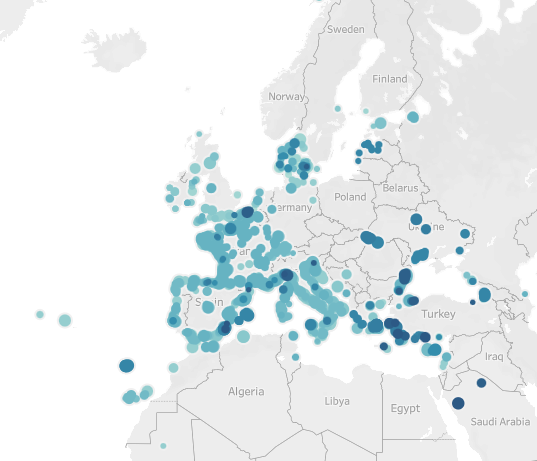
Marine Litter Watch data viewer
This Marine Litter Watch (MLW) data viewer provides a deeper look at the data collected by MLW communities. Available are charts and tables of both the data collected and community engagement.